The Art of Laser Etching: Craft, Precision, and What It Means for Memorial Stone

laser etching text on jet black monument.A photograph fades. A memory fades faster. Laser etching memorial stone gives a family a third option: a likeness that doesn’t fade at all. This is not a new category of monument; it’s a different answer to an old question, what does a name and two dates leave out? For a lot of families, the answer is a face. This piece covers why laser etching earns a place among memorialization options, who it tends to be right for, and what it actually takes to do well.

Why Families Choose It
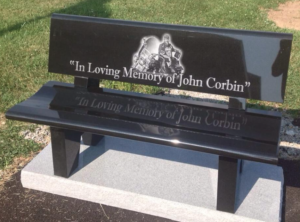
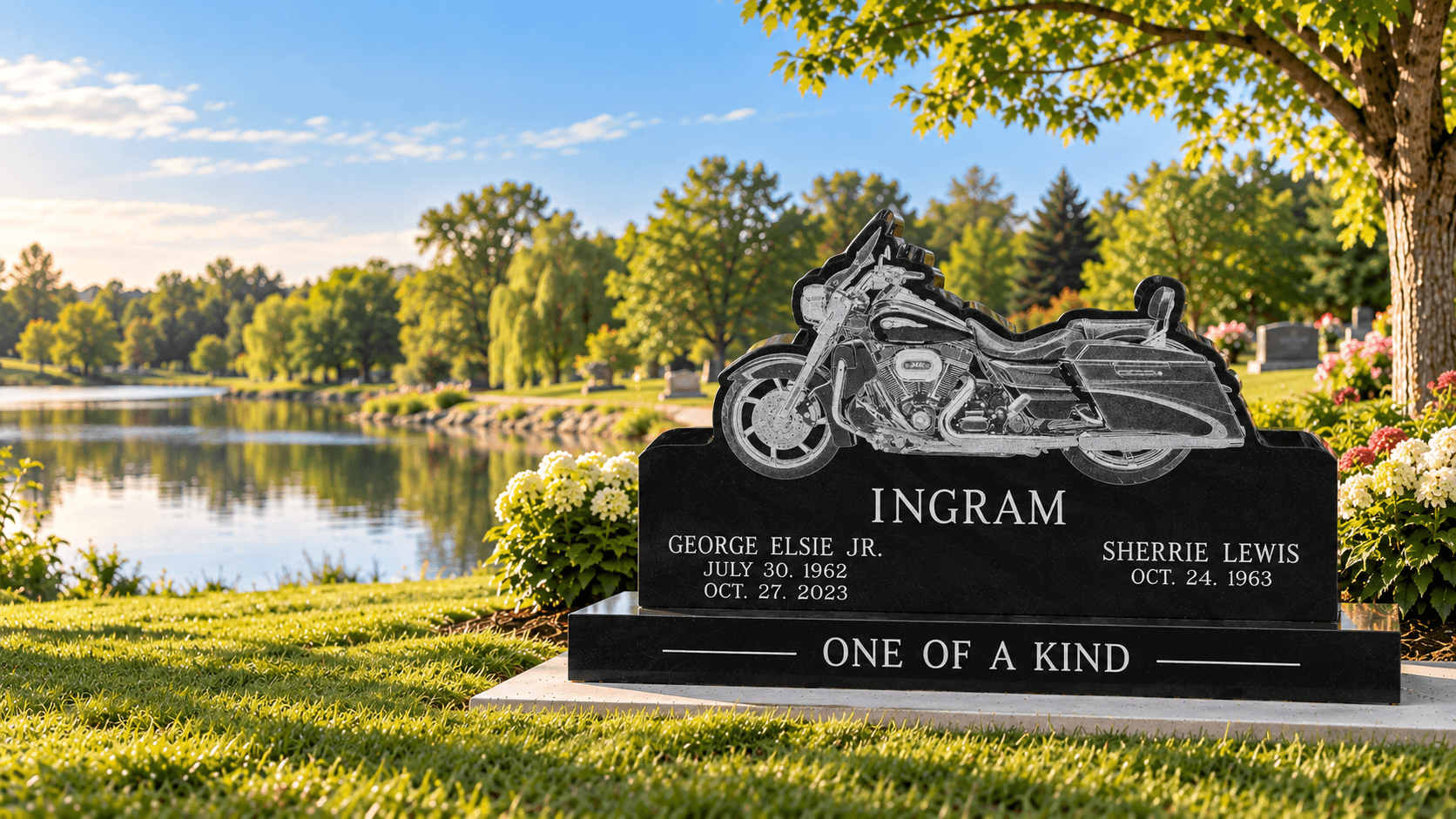
Jet Black park bench monument sitting on a concrete slab in a cemetery laser etched with image of motorcyclist and his bikeA name and dates tell you who is buried there. A portrait tells you who they were. That’s the gap laser etching fills, and it’s worth being specific about what it can actually do rather than describing it in the abstract.

The process lightens the surface of dense, dark granite in fine detail, building a photorealistic image without cutting depth into the stone. No stencil, no dust, no letters standing in for a face. Given a clear photograph and the right granite, it can hold an expression, not just a likeness: closed eyes versus open, a specific smile rather than a generic one. That specificity is the whole appeal. Families aren’t choosing laser etching because it’s a newer technology. They’re choosing it because it can put an actual face on the stone instead of an idea of one.

It isn’t the only way to add a portrait. Hand etching, done with a diamond-tipped tool, gives a more handcrafted look for families who want that instead of photo-realistic precision. Laser etching earns its place for speed and detail, not because it replaces the alternative.

Not Every Memorial Needs a Portrait, and That’s the Point

Jet black Special Septop with champers and laser etched collage. Etching features OSU football stadium and family photosLaser etching is a good fit for some memorials and not others. That’s worth saying plainly instead of pitching it as something every family should want.

It requires Jet Black granite specifically, because that stone’s fine, even grain is what produces the contrast a photo-realistic image needs. A lighter or speckled stone won’t hold the same result, no matter how good the source photo is. Sandblasting, by comparison, physically removes stone through a stencil process. It works on any granite color, gives bold, deep lettering, and is the better choice when the point is a strong inscription rather than a face.

Many memorials use both, sandblasted names and dates paired with a laser-etched portrait, because the two techniques are answering different questions. One says who. The other says what they looked like. A family choosing between them isn’t choosing better or worse, they’re choosing what they most want the stone to say.

Behind the Work

Laser Etching technician preparing file for laser.The craft only holds up if the people doing it treat every photo as somebody’s actual grandfather, not a file to process. That’s the standard this work runs on, so it’s worth naming the steps instead of claiming the care.

A photo or design request comes in first, often not in great shape, a decades-old print, a phone screenshot of a photo of a photo. That image goes through a design proof, which the family reviews and approves before any etching starts. Image processing can sharpen detail and repair damage in a photo that’s faded or low-quality, but it can’t decide which detail matters most to keep, or catch a technically clean proof that just doesn’t look like the person anymore. That judgment call is why every piece passes a second check before it moves forward. A machine can clean up a photograph. It can’t be the last set of eyes on someone’s face.

Who This Tends to Work Best For
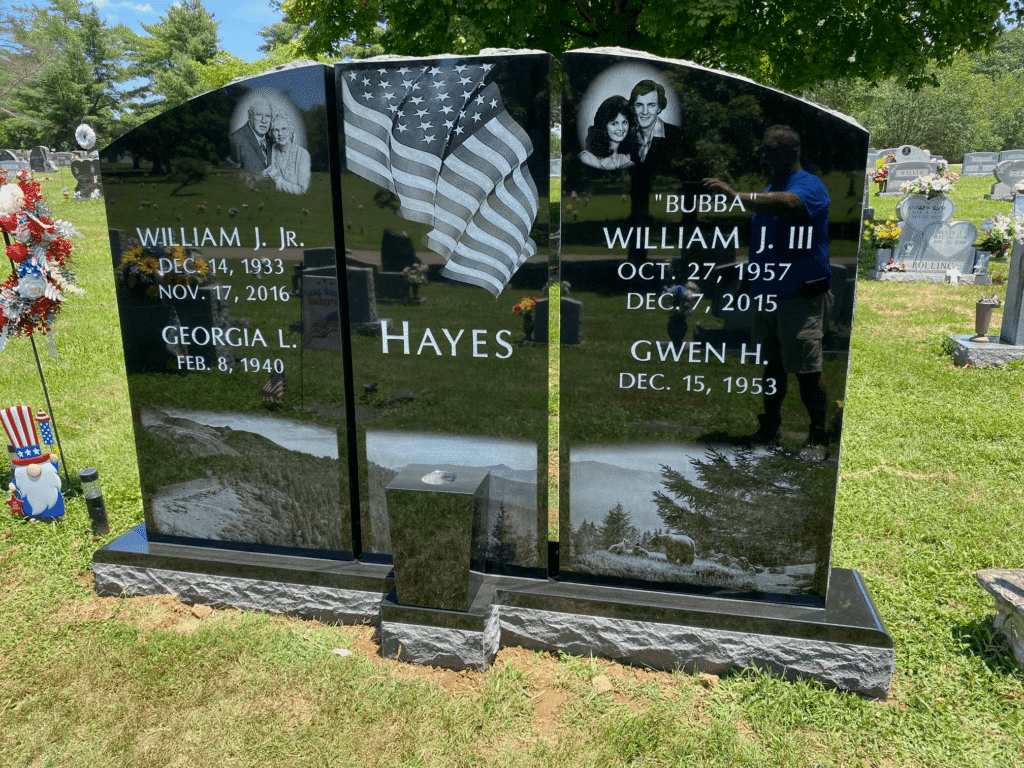
Jet black multi piece memorial with laser etchings of a flag, Mountain sceen featuring bears, and two images of a couple in their prime and later in life.This isn’t right for every family or every stone, and saying so up front saves a harder conversation later.

It works best when there’s a genuinely clear photo to start from; a real likeness comes through even a phone snapshot if the face is well-lit and in focus. It’s a strong fit for families who want the stone to be recognizable at a glance, not just readable. And it holds up over time in a way that matters for a monument meant to stand for generations: on Jet Black granite, a properly etched image can last decades, or even centuries, with minimal fading, because the etching changes the surface of the stone rather than sitting on top of it. Color is a separate, optional step, painted pigment over the etched image. The etch itself is permanent; the paint is weather-resistant rather than permanent, and typically holds about five years before it needs touching up. That’s a real distinction to walk a family through, not a footnote.

One more thing worth checking before a design gets promised: not every cemetery or diocese permits etched portraits. That’s a five-minute call that’s much better made before a family has already fallen in love with a design than after, and it’s one of a handful of questions worth having answers to before a dealer sits down with a family and walks them through what a laser-etched portrait can and can’t do.

Craft That Marks a Life
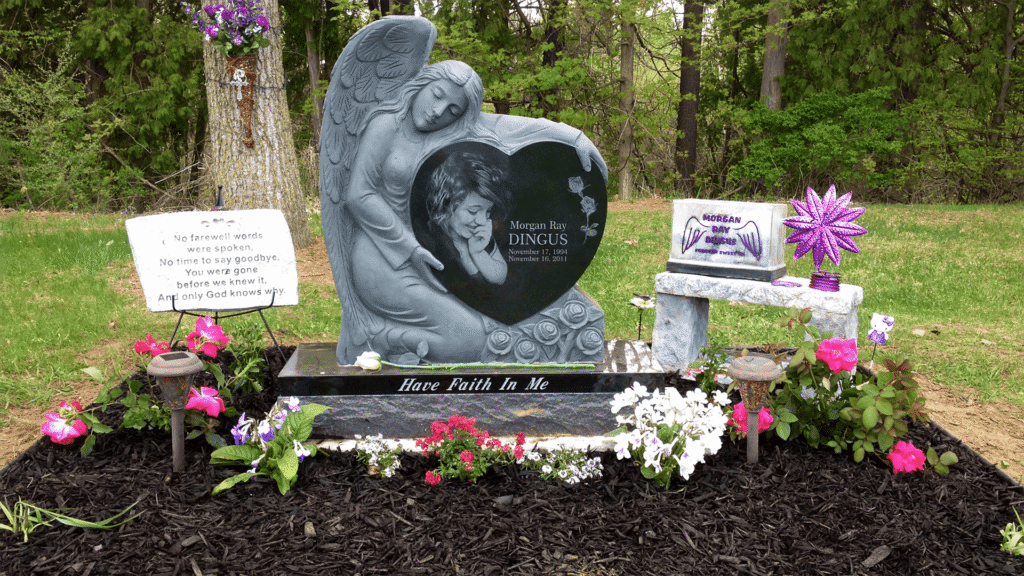
Angel holding Jet Black heart with laser etched portrait of woman sitting in a plot surrounded by other signs and flowers.Strip away the equipment and the workflow, and this comes down to a simple trade a family is making: do they want the stone to say who someone was, not just when. Laser etching is one good answer to that, not the only one, and knowing when it’s the right one is worth as much as knowing how it works. That kind of judgment is getting harder to lean on out of habit alone, since dealer expectations are shifting along with everything else in this market. Salem Stones has done this work in-house since 2011, on the belief that a face on a stone deserves the same care as the name beside it.
How to Clean Your Granite Memorial

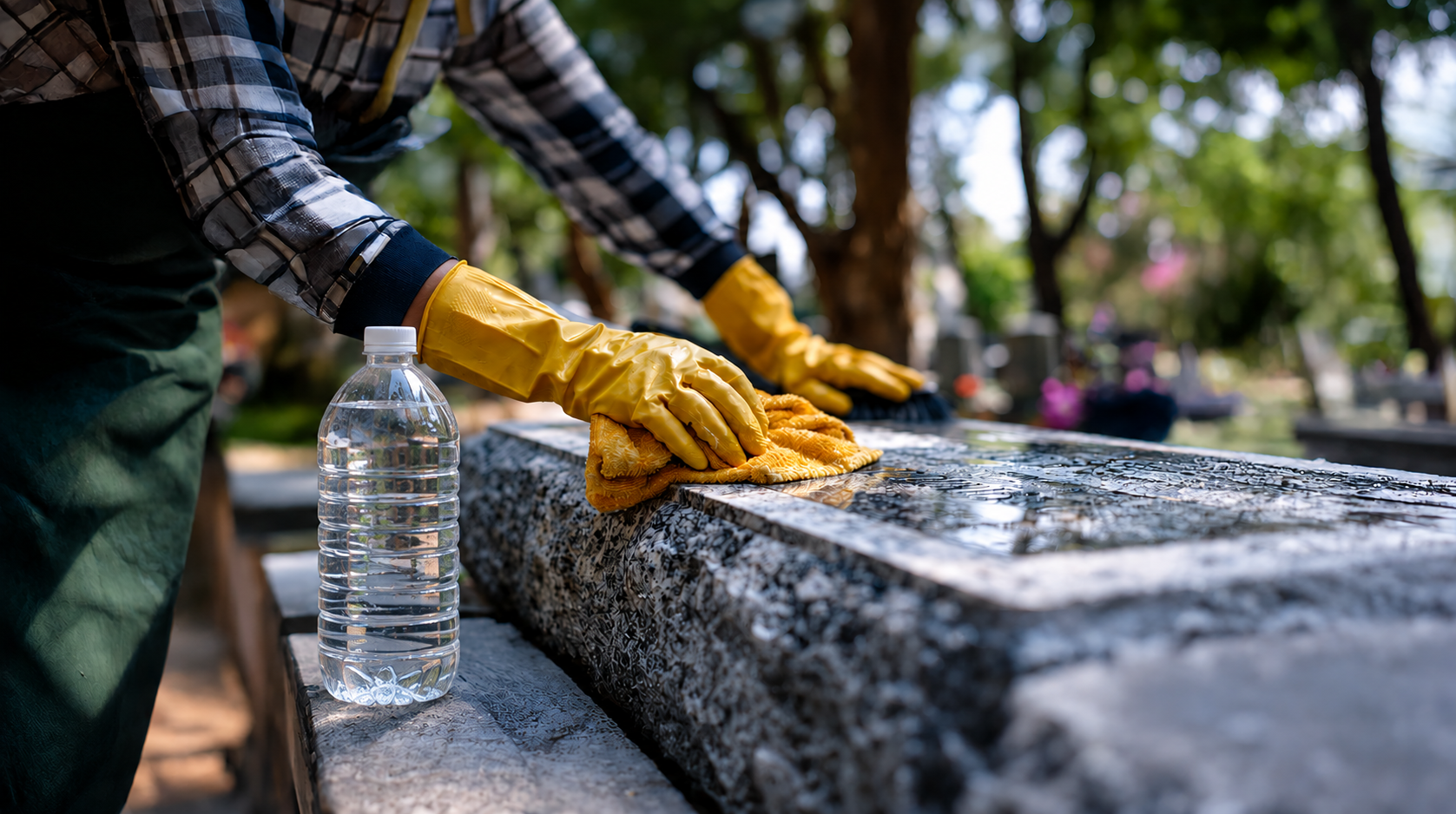
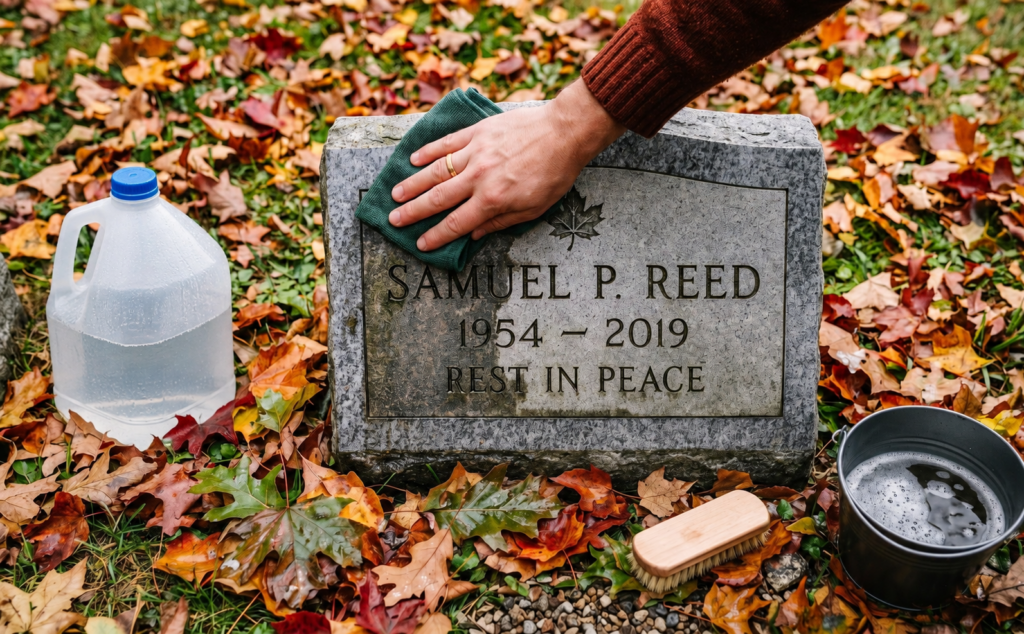
If you’re looking up how to clean a granite headstone without damaging it, here’s the good news: granite is one of the most durable materials used in memorial work, standing up to weather, freeze-thaw cycles, and staining in ways softer stones like marble simply can’t. Durable doesn’t mean maintenance-free, though. A little regular care is what keeps a memorial looking the way it should, for generations to come.

At Salem Stones, we believe proper care preserves the beauty. A memorial isn’t a purchase that ends the day it’s delivered. Caring for it, gently and correctly, is part of how a family or a cemetery continues to honor what it represents. The craftsmanship in every stone is meant to be visible for the long haul, and simple, consistent care is what keeps it that way.

Cleaning a granite memorial safely means matching the right method to the right kind of stain. Rust, organic growth, and embedded dirt each call for a different approach, and the wrong product or technique can do more harm than the stain itself. That’s why we put together a full guide covering safe, stain-by-stain cleaning steps, so you don’t have to guess.

Get the full step-by-step guide.


The Dealer Advantage in a Changing Memorial Market

The U.S. cremation rate hit 63.4% in 2025, up from under 40% a decade and a half ago. The Cremation Association of North America projects that number will reach 82.3% by 2045, with more than two out of three bodies cremated in an average year through the rest of this decade. Burial sits at 31.6% nationally, and stays meaningfully higher across the South, the Midwest, and Catholic markets.

That 82.3% is a projection, but one based on where things already stand. The monument dealer memorial market shift is structural, driven by mobility and changing cultural attitudes, not a passing trend that reverses with the next generation. What matters for a dealer is what this means locally. The national number is not your market’s number. A shop in a heavily Catholic county in Ohio or a rural Kentucky county is looking at a very different mix than a shop outside Phoenix. Understanding the national trend and then translating that into what it means for your specific inventory, supplier relationships, and shop’s future, is the first step toward using it rather than reacting to it.

Cremation Families Are Still Buying Memorials. The Product Mix Has Changed
The shift looks different up close: cremation families are not skipping memorialization. They are buying different products. Cremation benches, including companion versions built for two urns, flush granite markers, pedestals, and pillar-style memorials are the fastest-growing categories in the business right now. One industry source reports cremation bench inquiries tripling over two years. Dealers who built out cremation inventory saw those products reach 40% of total sales within eighteen months.

Average transaction values have held up through this shift, because families choosing a bench or a pedestal are still investing meaningfully in marking a life. The underlying need to memorialize has not changed. What has changed is which product answers that need.

There is also a real education gap, and it cuts in the dealer’s favor. SCI’s CEO told investors in a Q3 2025 earnings call that almost none of the cremation consumers his company surveyed knew what memorialization options existed for cremated remains, but roughly eight out of ten said they were interested once they saw the options. That gap between awareness and interest is where a knowledgeable dealer earns the sale.

Granite Pricing Is Genuinely Unpredictable Right Now. Here Is Why

India, Brazil, and China together accounted for 75.1% of processed granite import volume into the U.S. in the first half of 2025, so tariff policy on those three countries drives far more than most dealers outside the sourcing side realize. Tariffs on Indian stone rose from 25% to 50% in August 2025. Brazilian granite was hit as well. Tariffs on Chinese material swung between roughly 21% and over 100% across 2023 through 2025, with pauses and reversals along the way. One Cleveland monument company documented custom duty fluctuations on Chinese materials ranging from 21% to 59% over that span, a real illustration of what “unpredictable” means in practice.

Some dealers are absorbing these swings rather than passing the cost to a grieving family, which is admirable and also unsustainable as a permanent strategy. Others have delayed printing annual price lists because pricing could change again before the ink is dry. Whichever way an individual shop is handling it, the mechanics are the same: when the bulk of the country’s raw granite comes through three countries and all three have been subject to shifting tariff policy, price stability depends heavily on who is doing your sourcing and how well they understand total landed cost, not just the headline number on a slab.

What The Dealer Advantage Actually Looks Like In This Market

A few things separate dealers who are well positioned for where the market is heading from those who are not. Inventory mix that matches what families are asking for now, rather than what sold five years ago, is the first. A clear understanding of total landed cost in a tariff environment, instead of reacting to whatever number shows up on an invoice, is the second. Supplier reliability, meaning a partner who can tell you what is actually happening with pricing and lead times rather than surprising you, is the third.

The fourth is the one no online retailer or corporate operator can fully replicate: local presence. Design capability, personalization, and the kind of community relationships that come from being the shop a family has trusted for two generations. Online direct-to-consumer retailers compete hardest at the commodity end of the market, standard gray granite with simple inscriptions sold to price-sensitive buyers. They are far less of a threat to a dealer who can sit with a family, understand what they need and want, and deliver something personal. That is not a defensive posture. It is the one advantage no online retailer can buy, and it holds regardless of which supplier a shop buys from.

The Long View: What The Memorial Market Looks Like In Five Years

Burial is not disappearing. In the South, the Midwest, and heavily Catholic markets, burial rates will stay above the national average for years, and the demand for traditional upright monuments in those regions will hold strong. The global tombstone market is valued at $13.47 billion in 2025 and projected to grow past $20 billion by 2035. The product mix is changing. The business itself is not.

Two channel shifts are worth watching without treating them as adversaries. Funeral homes, including large chains, increasingly offer memorialization directly as part of packaged at-need services, because they have first contact with the family and the purchase can happen within days rather than months. Some corporate cemeteries lean on preferred-vendor arrangements for the same reason. Neither of these is new behavior so much as an extension of dynamics that have always existed in this business, and neither one is the enemy. They are other participants navigating the same structural shift.

What holds steady through all of it is what a dealer offers that no other channel replicates: sitting with a family, understanding what they actually need, and guiding them to something that will still have meaning in fifty years. The dealers who invest now in cremation product knowledge, in understanding their real landed cost, and in the relationships that built their business in the first place are the ones positioned to hold their ground, and to pick up the customers left behind as the industry consolidates around them. The fundamentals of why this business exists have not changed.

If you have questions about what these numbers mean for your business, we’re here to help.


Sources: Cremation Association of North America (CANA); Stone Depot US, April 2026; SCI Q3 2025 earnings call via Funeral Director Daily, December 16, 2025; CNBC, November 30, 2025; StoneNews.eu, August 2025; Stone World, October 2025; Global Growth Insights, February 2026. Full sourcing detail in the companion content brief.

Our Team is here to help

Click on your state to find your Regional Manager